

Electric vehicles are no longer the future of commercial fleets – they’re the present. From last-mile delivery vans and yard trucks to terminal tractors and medium-duty work vehicles, fleet operators across North America are making the switch. But buying electric vehicles is only half the equation. The other half – and arguably the harder one – is figuring out how to charge them reliably, affordably, and at scale.
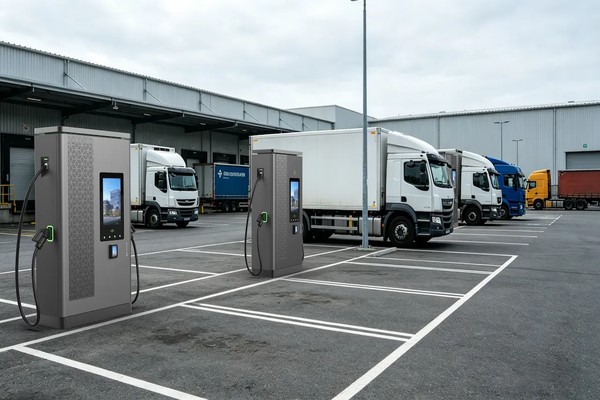
That’s where depot fleet chargers come in. Unlike public charging networks designed for one-off consumer use, depot chargers are purpose-built for the rhythms of commercial fleet operations. Here’s why they’ve become the cornerstone of any serious electrification strategy.
1. Predictable, Centralized Charging
Fleets thrive on predictability. Drivers need vehicles ready at shift change, dispatchers need accurate range data, and operations managers need to know that downtime won’t blow up the day’s schedule. Depot charging delivers all of that by centralizing energy delivery at the place vehicles already return to every night.
Instead of hunting for public chargers or hoping a third-party network is operational, your fleet plugs in at home base. Vehicles charge during off-shift hours and roll out the next morning at full state of charge. It’s the simplest, most reliable way to keep an electric fleet moving.
2. Dramatically Lower Energy Costs
Public DC fast charging is expensive – sometimes two or three times the cost per kWh of charging at a depot. Multiply that across hundreds of vehicles and thousands of charging sessions per year, and the savings from depot charging become impossible to ignore.
Better still, modern depot charging infrastructure can be programmed to charge during off-peak utility windows when electricity rates are at their lowest. Battery-integrated systems take this even further by storing cheap overnight energy and dispatching it to vehicles on demand, sidestepping costly demand charges that often account for 30 to 70 percent of a fleet’s monthly electricity bill.
3. Faster Deployment Than You Think
One of the biggest myths about depot electrification is that it requires years of utility coordination and construction. Traditional builds often do – transformer upgrades, switchgear installation, and permitting can stretch projects out 12 to 24 months.
But newer solutions are changing that math. Companies like OptiGrid offer fleet depot charging infrastructure that runs on existing on-site power thanks to onboard battery storage. That means deployments in 4 to 6 weeks instead of years – a game-changer for operators racing to hit electrification deadlines.
4. Scalability That Matches Fleet Growth
Few fleets electrify all at once. Most start with a pilot, prove out the economics, and expand from there. Modular depot charging supports that approach perfectly. You can add chargers as you add vehicles, avoiding the trap of overbuilding infrastructure for a fleet that doesn’t yet exist.
And if your operation moves? Modular, battery-integrated chargers can move with you – a critical advantage for operators in leased facilities.
5. Smarter Operations Through Data
Modern depot chargers aren’t just power outlets. They’re connected assets that feed energy consumption data, charging patterns, and vehicle readiness reports directly into your fleet management systems. OCPP-compliant platforms integrate seamlessly with telematics tools you already use, giving managers a single pane of glass to monitor every charger across every site.
That visibility translates into real operational gains: fewer surprises, better-utilized vehicles, and lower lifetime energy costs.
The Bottom Line
Depot fleet chargers aren’t just a nice-to-have – they’re the foundation of profitable, scalable fleet electrification. They cut energy costs, eliminate range anxiety, integrate with existing operations, and increasingly, deploy fast enough to match the pace of business.
For fleet operators ready to electrify without waiting on the grid, the right depot charging partner makes all the difference.

Comments are closed.